GLP-1 Muscle Loss After 50: The Menopause Myth That Could Cost You Your Strength
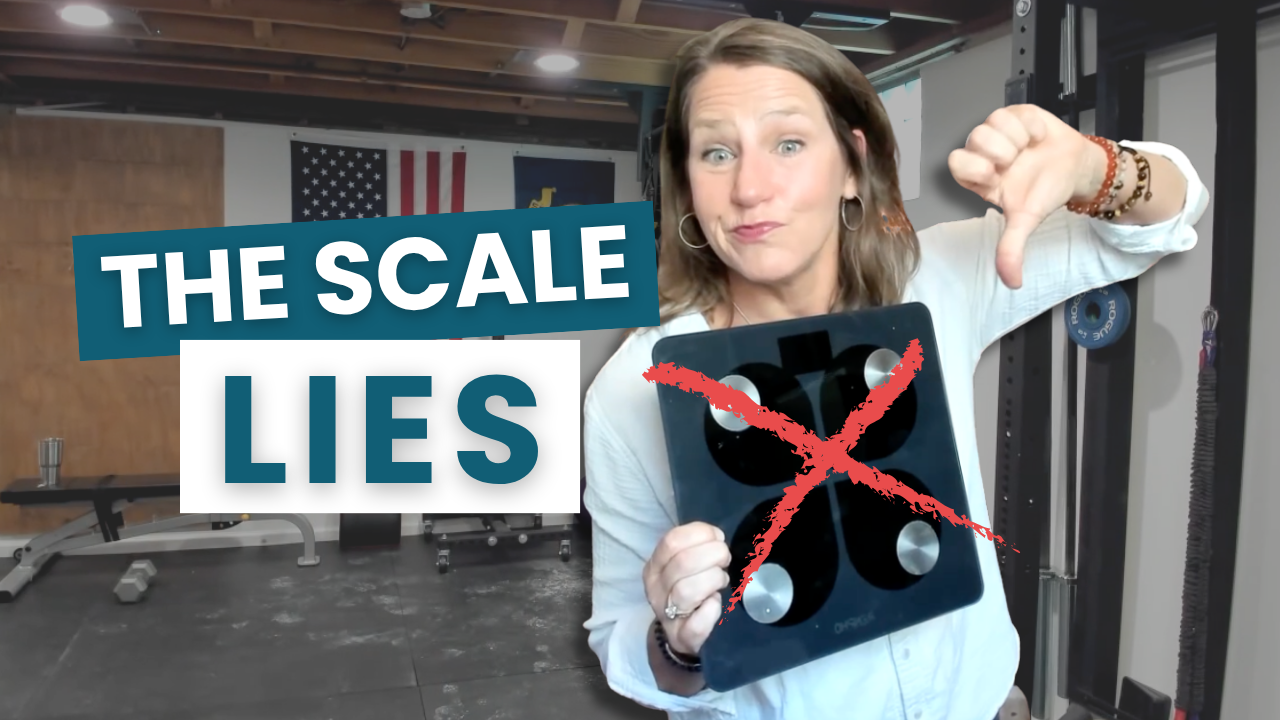
GLP-1 Muscle Loss in Menopause: The Myth That Could Cost You Your Strength
If you are on a GLP-1 and the scale is finally moving, that is worth celebrating. But a dropping scale is not a sign to stop exercising. In big studies on these medications, close to 40% of the weight people lost was lean mass, not fat. For women over 50 in menopause, protecting that muscle and bone matters more than how fast the number goes down.
I am a holistic health coach, and I am not for or against GLP-1s. What I am for is strong, healthy aging, so you can enjoy your life. So let's talk about the myth, the research, and the three simple ways I help my clients on GLP-1s keep what matters.
The Menopause Myth: “The Scale Is Moving, So I Can Coast”
The myth goes something like this. The shot is doing its work. The number keeps going down. So I really don't need to exercise anymore.
I totally get why that feels true. After years of the scale barely budging, it finally moves. But coasting right now, when your body is most at risk of losing muscle and bone, can easily backfire.
What the Research Shows About GLP-1 Muscle Loss
In the STEP 1 trial on semaglutide, a group of 140 people had DEXA scans to measure their body composition. About 39% of the weight they lost was lean mass. A similar group in the SUSTAIN 8 trial landed right around 40%.
Here is what that can look like in real life. Say the scale goes down 30 pounds. Anywhere from 10-ish to 12 of those pounds could be lean mass if you are not doing anything to hold on to it.
Lean mass is mostly muscle, along with water and other tissue that is not fat. And the ratio is not set in stone. Research reviews show the share of lean mass lost gets much smaller when people pair these medications with strength training and enough protein. Your habits help decide the quality of your weight loss.
Bone matters too. In a one-year randomized trial published in JAMA Network Open, people who took a GLP-1 without exercise lost bone density at the hip and spine. People who took the same medication and exercised kept their bone density, even though they lost the most weight of any group.
Why GLP-1 Muscle Loss Matters More for Women After 50
After menopause, we are already working to hold on to muscle and bone as estrogen drops. I covered this in my belly fat series. If you add a medication that can pull more muscle off your frame, and you do nothing to push back, you could speed up the very thing menopause is already doing.
This is not about looks. It is about the rest of your life.
- Muscle is your metabolism. It is where your body parks and burns blood sugar.
- Muscle keeps you independent. It is how you get up off the floor with your grandbaby without needing a hand.
- Bone keeps you steady. Strong bones are how you avoid breaking a hip at 70.
You are going to lose weight on this medication. The part you get to decide is the quality of that weight loss. Do you come out on the other side lean and strong? Or smaller, softer, and more fragile than when you started?
3 Ways to Protect Muscle and Bone on a GLP-1
1. Lift something heavy for you
Your body needs a reason to keep your muscle, and strength training is that reason. Aim for about 60 minutes a week. It can be in 10-minute chunks, the way I do it in my Menopause Minis. Lifting something that challenges you tells your body, “these are important, let's keep them.”
New to lifting? The Menopause Mini Strength Program is a simple place to start: https://www.camoyler.com/offers/dNzq2xmR/checkout
2. Eat your protein first
Most women eat less on a GLP-1. That makes protein a non-negotiable. It is the raw material your muscles and bones are built from. Even on days the medication takes your appetite away, let protein come first. A simple starting point is a palm-sized portion at every meal.
Want more on how much you need? Watch: In Menopause, How Much Protein Do You Need and How Do You Get It: https://youtu.be/62FS7FhNE-U
3. Get proof with a DEXA scan
A scale only shows one number. A DEXA scan shows what that number is made of, including your muscle and your bone. Remember that 30-pound example? On a scale, it is just 30 pounds. On a DEXA report, you can see what you lost and what you kept.
Seeing is believing. Once you see your own muscle on paper, the temptation to skip your workout gets a lot quieter. You are not guessing anymore. You know.
Not sure where to find one? Ask your doctor or a local gym. Many gyms offer an InBody scan, which is one step below a DEXA, and a quick search will show DEXA options near you.
Smaller Is Not the Goal. Stronger Is.
So that's the whole game. Strength, protein, and some proof for your brain. You keep your muscle and bone, and you let the fat go. Now the scale is dropping and something good is happening on the inside too.
A dropping scale on a GLP-1 is a beautiful thing. It is not the finish line. It is the starting line for building a strong body. You are not just losing weight. You are deciding who you are going to be at 60, 70, and 80. I hope that woman is a strong one.
Frequently Asked Questions
Do GLP-1 medications cause muscle loss?
GLP-1s do not attack muscle directly. They lower appetite, so you eat less and lose weight. Any big weight loss can take some lean mass with it, especially without strength training and enough protein.
How much muscle do you lose on a GLP-1?
In the STEP 1 and SUSTAIN 8 trials, about 39% to 40% of the weight lost was lean mass. That share tends to be smaller when people strength train and eat enough protein.
Can you build muscle after 50 while on a GLP-1?
Yes, with the right signals. Strength training gives your body a reason to keep and build muscle, and protein gives it the building blocks. Women over 50 can still gain strength while losing fat.
How much strength training do you need on a GLP-1?
I suggest about 60 minutes a week of lifting something heavy for you. Short 10-minute sessions count and add up.
How do you know if you are losing fat or muscle?
A scale can't tell you. A DEXA scan measures your fat, muscle, and bone, so you can see what you are losing and what you are keeping.
Keep Learning
- Menopause Belly Fat, Part 1: Why More Exercise Isn't Working: https://youtu.be/3m_3Yl-yvIU
- Menopause Belly Fat, Part 2: 3 Hormones Storing Fat in Your Middle: https://youtu.be/LeqZrIACvKo
- Lower Blood Sugar in Menopause Means Less Belly Fat: https://youtu.be/1YjSwxlFNDI
- Menopause Myths: The Fasting Myth: https://youtu.be/SpAtZ2mClcc
- Free Midlife Bone Care Guide: https://www.camoyler.com/boneguide
Work With Me
I walk my clients through this every day, including women who are on GLP-1s right now. Together we protect muscle, bone, and metabolism with strength training and nutrition, so the weight you lose is the right kind of weight.
- Start with my free resources: https://www.camoyler.com/menu
- Apply to work with me 1:1: https://calendly.com/cam-heymomma/apply
About Cam Allen. Cam is a functional health coach and the founder of Midlife Method with Cam Allen®. She helps women over 50 build strength, eat to fuel their bodies, and see menopause as an upgrade. She holds CrossFit L1 and L2 certifications, NLP Mastery certification, and multiple metabolism and hormone health certifications, and she spent 18 years as an elementary school teacher before coaching.
This article is for education only. I am a functional health coach, not your doctor. Please talk with your doctor about your medications, labs, and any changes to your exercise or nutrition.
